Eby Wants Critical Minerals. His KSM File Says Uncertainty.
B.C. cannot sell itself as a critical-minerals powerhouse while investors watch court-ordered consultation do-overs and a new-claims pause across the northwest.
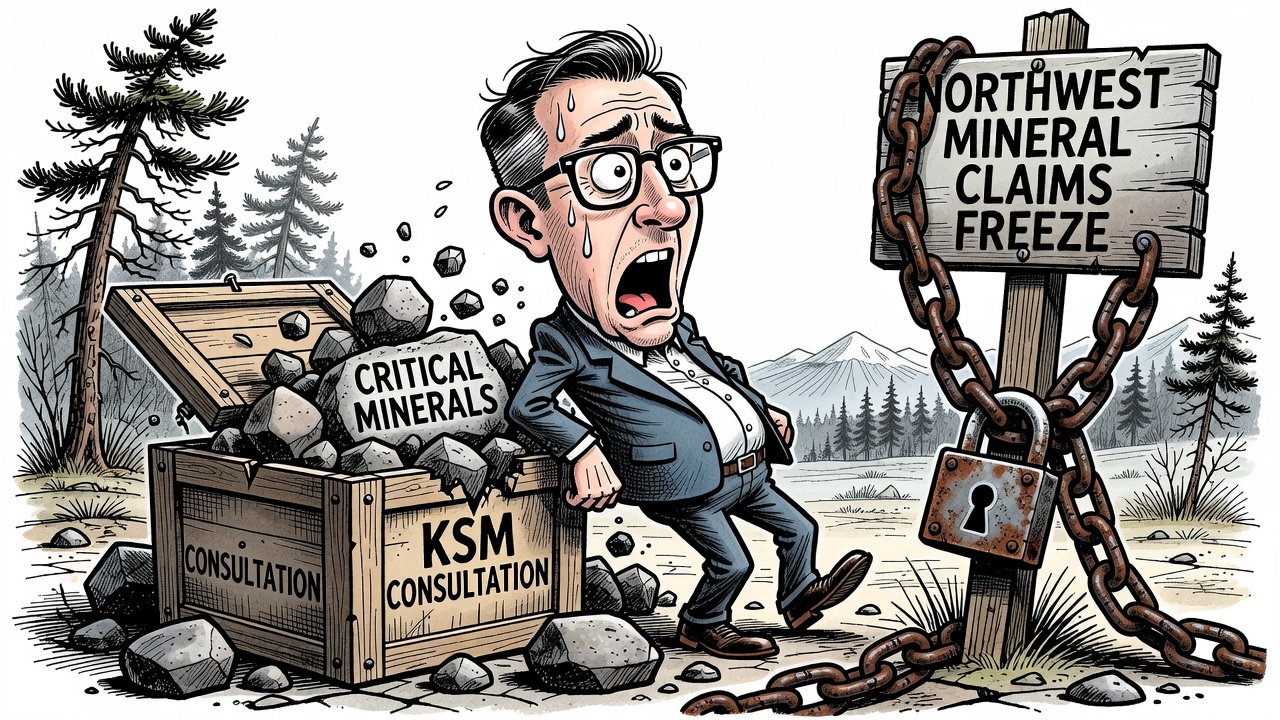
The NDP keeps announcing certainty. The record keeps producing exceptions, pauses and court fixes.
David Eby wants British Columbia to look like a critical-minerals superpower. The KSM file shows why the sales pitch is not enough.
KSM, Seabridge Gold’s proposed gold-copper project in northwestern B.C.’s Golden Triangle, is not a side issue. Canadian Press reported that it has been called the largest undeveloped gold mining project in the world. Seabridge says it has spent about $1.2 billion at the site. Its own 2026 filings describe KSM as one of the world’s largest undeveloped gold and copper projects.
Then came the consultation problem. On June 8, Seabridge reported that the B.C. Supreme Court found the Environmental Assessment Office’s “substantially started” determination was reasonable, but also found the EAO had not engaged in sufficient consultation with Tsetsaut Skii km Lax Ha. The court ordered a 90-day written-submissions period before the Province reconsiders the determination. Canadian Press separately reported that the court said B.C. did not satisfy its duty to consult before declaring the mine substantially started.
That matters because the substantial-start declaration is not paperwork trivia. CP reported that it meant the project did not need a new environmental assessment. Seabridge says work will continue during the process. That is an important caution: this is not a cancellation story. It is a certainty story.
And certainty is exactly what the Eby government claims to be selling. Seabridge’s Q1 MD&A says the Province designated KSM a provincial priority project after quarter-end, with dedicated permitting coordination and support expected to streamline future permit applications. The same filing also says a decision on permit amendments for the Mitchell Treaty Tunnels had been delayed.
Zoom out and the contradiction gets sharper. On June 3, B.C.’s Ministry of Mining and Critical Minerals extended a pause on new mineral and placer registrations in parts of northwestern and north-central B.C. until Jan. 31, 2027. The Province says the pause supports land-use planning with First Nations and does not affect existing tenures. Critics, including the Fraser Institute, say the affected area covers roughly 16 million hectares and clashes with the government’s critical-minerals narrative.
Those two things can both be true: consultation is legally necessary, and the NDP still owns the consequences when its process leaves companies, workers, First Nations, local governments and investors waiting for the rules to settle.
B.C. does not need another glossy pitch deck. It needs a government that can consult early, decide clearly, publish timelines, protect existing rights and tell the truth about tradeoffs before billions of dollars and northern jobs are left hanging.
The KSM lesson is blunt: critical minerals require more than speeches. They require a province that can govern.
Sources and records
- Canadian Press via Journal of Commerce, June 10, 2026: B.C. court finds province didn’t properly consult First Nation on northwest gold mine
- Seabridge Gold, June 8, 2026: B.C. Supreme Court decides KSM substantially-started determination reasonable
- Seabridge Gold SEC filing, Q1 2026 MD&A
- B.C. Government, June 3, 2026: Continuing tenure pause until Jan. 31, 2027
- Fraser Institute, June 18, 2026: Golden Triangle mining, moratorium and litigation commentary