Eby’s Tahltan Talks Just Got Ottawa’s Blessing
The issue is not whether Tahltan communities should benefit from development. The issue is whether David Eby can negotiate land, revenue and governance changes while the public gets only fragments.
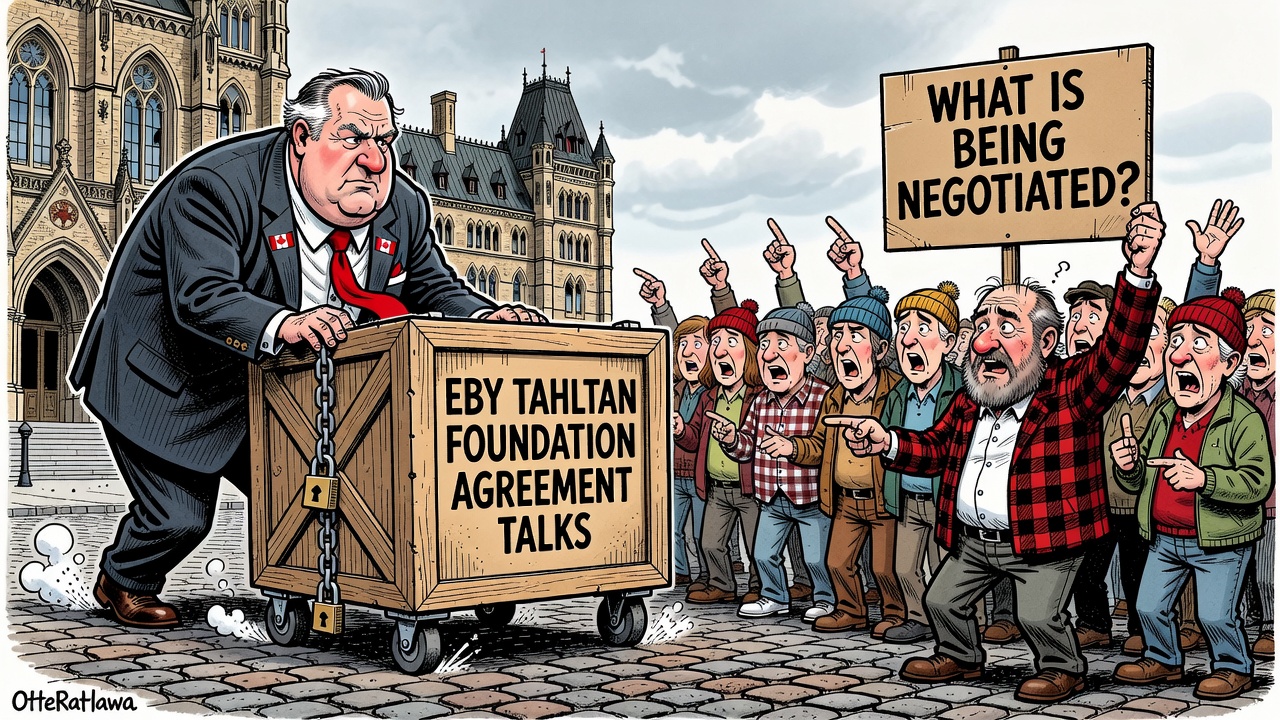
Certainty for mines cannot mean uncertainty for voters.
David Eby says B.C. needs predictable permitting, critical-mineral investment and partnership with First Nations. Fine. But the federal government’s own July 2 prosperity agreement confirms something much bigger is moving: Ottawa will look for ways to join and fund the Tahltan Foundation Agreement currently being negotiated between British Columbia and Tahltan.
That is not a rumour. It is in the Prime Minister’s backgrounder, under the northwest critical-minerals section. The same agreement says its implementation committee will work on listed timelines, and Annex A puts the Tahltan item in the group due on or before December 1, 2026.
Now add the reporting that triggered the alarm. Northern Beat reported July 3 that FOI records obtained by the Public Land Use Society point to negotiations involving governance, land transfers, revenue sharing and recognition of Tahltan rights and title across Tahltan territory. Those are allegations and descriptions from reporting on redacted records, not a signed public agreement. That distinction matters. It also makes the transparency problem worse, not better.
If the government can brief Ottawa, investors and negotiating tables, it can brief British Columbians. What land is being discussed? What revenue streams are on the table? What decision-making powers could shift? How would private property rights, mineral tenure, local governments and non-Tahltan residents be protected? And who gave Eby a public mandate to settle questions this large outside the treaty process?
The province’s own record shows this file is not theoretical. B.C. has already used Declaration Act consent-based decision-making with Tahltan on major mining projects, including Red Chris and Eskay Creek. The June Red Chris release celebrated a streamlined joint process, job creation and the project’s move from open pit to underground mining. It also made Eby’s pitch clear: partnership agreements create certainty for major projects.
But certainty cannot be one-sided. Mining companies need rules they can rely on. First Nations deserve serious negotiation and real economic participation. Workers need projects that actually proceed. Taxpayers, landholders and voters need to know whether the NDP is negotiating changes to governance, land, revenues or title recognition before those decisions become political facts.
Eby’s government often sells DRIPA as reconciliation plus economic growth. The Foundation Agreement talks are the test. If the model is sound, publish the framework, map the affected interests, explain the legal basis and let the public scrutinize it before December 1.
If the public only learns the real scope through FOI records and federal backgrounders, then this is not predictable government. It is a quiet rewrite of resource governance in one of B.C.’s most valuable regions, with ordinary British Columbians invited to read the fine print after the power has already moved.
Sources and records
- Northern Beat, July 3, 2026: Backed by Ottawa, B.C. negotiates governance, Aboriginal title in mineral-rich northwest
- Prime Minister of Canada, July 2, 2026: Canada-British Columbia Cooperative Prosperity Agreement
- BC Gov News, June 19, 2026: Red Chris expansion approved following joint decision-making process
- BC government: Tahltan Central Government agreements and negotiation page